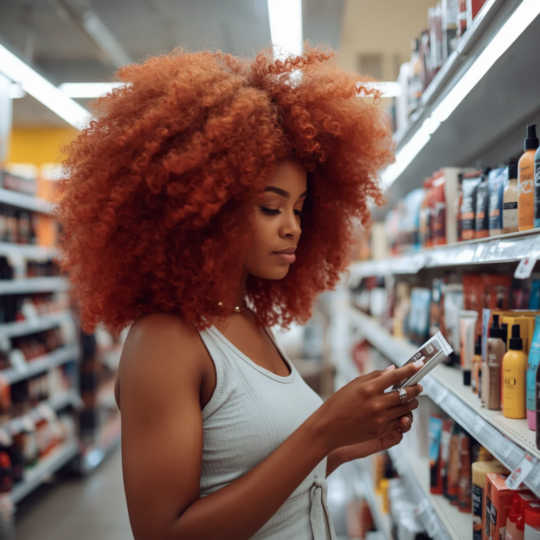
How to Choose the Right Natural Hair Products Without Wasting Money
Stop product hopping. Start choosing with a purpose.
Hey curlfriend, if you’ve ever purchased a product because someone with beautiful curls recommended it, watched a few YouTube reviews, added it to your cart, and eagerly waited for wash day, only to discover that it didn’t work the way you expected, you’re not alone.
And if you’ve repeated that process more times than you’d like to admit, we need to talk.
The natural hair industry has no shortage of products. There are shampoos, conditioners, deep conditioners, leave-ins, creams, gels, mousses, oils, butters, custards, foams, and just about everything in between. New products and new promises seem to appear every week.
With so many choices, it’s easy to believe that the next product might finally be the one that changes everything.
But here’s something I want you to consider: The problem may not be that you haven’t found the right product. The problem may be that you haven’t figured out what you’re actually looking for.
As a pharmacist, curlfriend, and someone who has spent years working with textured hair, I look at product selection a little differently. Instead of choosing products based on trends, I want to understand what a product is designed to do, how its formulation supports that purpose, and whether it makes sense for the person using it.
That’s the approach I want to share with you.
At Bold Kulture Beauty, we’re not interested in helping you collect more products. We’re interested in helping you make better decisions about the products you purchase, so you can spend less time guessing and more time understanding what your hair needs.
If you’re ready to stop guessing and be more intentional about product selection, let’s get into it!
1. How Do I Know Which Natural Hair Products Are Right for My Hair?
This is probably one of the most common questions I hear, and I understand why.
You want products that help your hair feel good, look good, remain manageable, and support your hair goals. But with so many options, where do you start?
I would start by taking a step back from the products themselves.
Before you look at a brand, an ingredient, or a product recommendation, take a look at your own hair.
There are a few things worth considering:
Your hair’s unique characteristics
It’s no secret that I’m not a big fan of curl typing, but I know many curlfriends still rely on it. While this system can help describe your curl pattern, it doesn’t tell you everything you need to know about choosing products or the condition of your hair.
Two people with type 4 hair can have completely different product needs and get completely different results with the same product. That’s why I recommend selecting products based on the unique characteristics of your hair (beyond curl type) and its specific needs.
One person may have fine strands that become weighed down easily. Another may have thicker strands that need more conditioning support. One may have a dense head of hair, while another has lower density and needs to be more mindful of how much product is applied.
If you want to become more intentional and avoid the product-hopping lifestyle, start by learning about your hair, its unique characteristics, and specific needs. Your curl pattern is one piece of the puzzle, not the entire picture.
Your hair’s condition
Where does your hair fall on the healthy-to-damaged spectrum? Is your hair feeling dry? Are you experiencing excessive tangling? Does it feel rough or difficult to manage? Are you noticing more breakage than usual?
These observations can help you identify what your hair-care routine may be missing.
For example, color-treated curls, hair that is difficult to detangle, or hair coming out of or going into a protective style may benefit from a bond corrector or conditioner with protein and good lubricating and conditioning properties. Hair that feels dry, coated, or weighed down may need a more effective cleansing approach rather than another moisturizing product. That is why knowing your hair’s condition matters.
The key is to identify the concerns and where your hair falls on the healthy-to-damaged spectrum before deciding what to purchase.
Your styling goals and lifestyle
Let’s be realistic. The best routine is one you can actually maintain.
Do you wear wash-and-go styles, twist-outs, braid-outs, or other protective styles? How often do you cleanse your hair? How much time are you willing to spend styling? What does your day-to-day life look like? Are you exercising regularly? Do you live in a humid or dry climate? Do you require more frequent wash days?
A product that works beautifully for someone who styles their hair every three days may not be the best choice for someone who wants a style to last 7-10 days.
Your lifestyle matters just as much as the unique characteristics of your hair.
Your hair’s response to products
Pay attention to how your hair responds during and after product application.
Does your conditioner make detangling easier? Does your styler provide the hold you want? Does your hair feel excessively coated after repeated applications? Are your products just sitting on top of your hair? Did you follow the directions? Have you layered your products, or are you using a single product?
These observations are more useful than simply deciding that a product is good or bad based on someone else’s review.
The goal is to understand what your hair responds to, not to chase every new recommendation.
2. Why Do Products That Work for Someone Else Fail for Me?
Here’s where product hopping often begins. If you’re tired of collecting products that don’t work, stop chasing results and start choosing the products you need with intention.
You see someone demonstrate a product. Their curls look amazing. They explain how soft, defined, moisturized, or manageable their hair feels. Naturally, you want to experience the same results.
You purchase the product, follow their instructions, and wait for the magic.
Except it doesn’t happen.
Before you decide that the product is terrible, consider this: You and that person may not have the same hair characteristics, needs, styling techniques, or expectations.
Let’s take a closer look at a few of these reasons to discover why your results may be coming up short.
Different hair characteristics
Even when two people have the same curl pattern, their strand thickness, density, condition, and length can be very different.
A rich styling cream may provide the conditioning and definition one person wants but leave another person’s hair feeling heavy.
A lightweight leave-in may be perfect for someone who doesn’t need much additional conditioning or weight to their products but insufficient for someone who needs more help with detangling and manageability.
The product hasn’t necessarily failed. It may simply not be the right match.
Different formulations
A product’s name doesn’t tell you everything about what it can do.
Two products marketed as moisturizing conditioners can have very different formulations. Their conditioning agents, emollients, humectants, and other ingredients may differ or be very similar. This doesn’t mean your results will be.
Despite similarities and marketing claims, they may perform differently, even though they’re designed for the same general purpose.
This is one reason I encourage Curlfriends to look beyond the front of the bottle.
Different application techniques
This is a big one.
How much product are you using? Is your hair sufficiently wet or damp when you’re applying it? Are you working in sections? Are you distributing the product evenly? Should this product be layered or used alone?
These details can influence your results.
A styling product applied to dry hair may behave differently than the same product applied to thoroughly wet hair. Applying too much product can create buildup or leave the hair feeling coated. Applying too little may not provide the coverage or hold you’re expecting.
Sometimes, what needs to change isn’t the product. It’s how you’re using it.
Different expectations
We also need to talk about expectations.
A product that provides excellent conditioning may not provide strong hold. A gel that creates definition may not be designed to provide the softness you expect from a cream.
When we expect one product to do everything, we’re setting ourselves up for disappointment.
Products have purposes. Understanding those purposes helps us evaluate them more fairly.
3. What Should I Consider When Choosing a Shampoo, Conditioner, Leave-In, or Styler?
This is where I want you to start thinking about products in terms of function.
Instead of asking, “What’s the best shampoo for natural hair?” ask, “What do I need my shampoo to accomplish?”
The same question applies to every product in your routine.
Shampoo: Start with cleansing
Your shampoo has a job to do: cleanse your scalp and hair.
It helps remove excess oil, sweat, dirt, dead skin cells, and accumulated styling products.
Not all shampoos cleanse in the same way. Some are designed for regular cleansing, while others are formulated to provide a more intensive cleanse.
The right choice depends on your scalp, your styling practices, how frequently you cleanse, and how much product you use.
One thing I want to emphasize is that cleansing your hair is not something you should avoid because you are afraid of dryness.
A healthy hair-care routine needs an effective cleansing step. If you regularly use gels, creams, oils, or other styling products, you also need to consider how that buildup is being removed.
What to look for: A routine hydrating shampoo that cleanses effectively without leaving your hair overly stripped or hard to manage, and a clarifying shampoo that you can use less often to remove excess buildup.
Conditioner: Support manageability and reduce friction
Conditioners are not interchangeable with shampoos, and they aren’t simply an optional extra.
Their primary functions include improving manageability, reducing friction, helping with detangling, and making the hair easier to handle.
Conditioning ingredients can help smooth the hair surface and improve how the strands interact with one another.
This is especially important for curly and coily hair, which can be more susceptible to tangling and mechanical breakage.
What to look for: A conditioner that provides the level of conditioning and detangling support your hair needs.
Also, remember that rinse-out conditioners, deep conditioners, and leave-in conditioners have different intended uses. You don’t necessarily need to purchase every category, but you should understand what each one is designed to do.
Leave-In Conditioner: Additional conditioning support
A leave-in conditioner is designed to remain on the hair after application.
Depending on its formulation, it may provide additional conditioning, improve manageability, help with detangling, and prepare the hair for styling.
But here’s something important: Not everyone needs a heavy leave-in, and not every leave-in will work with every styler.
If your hair is fine or easily weighed down, a lightweight formula may be more appropriate. If your hair needs additional conditioning support, you may prefer a richer formulation.
What to look for: A leave-in that complements your rinse-out conditioner and styling products without creating unnecessary buildup or weighing your hair down.
Stylers: Choose based on the finish you want
This is where things can get confusing because there are so many different types of styling products.
Gels, creams, mousses, custards, foams, and styling lotions can all serve different purposes.
Some are designed to provide hold. Others focus more on definition, flexibility, volume, or reducing frizz.
For example:
- A gel may provide hold and help maintain curl definition.
- A styling cream may provide conditioning, softness, and some definition, but without hold.
- A mousse or foam may provide lightweight to moderate hold, volume, or styling support, depending on its formulation.
- A custard may combine conditioning and styling properties.
Don’t choose a styler simply because someone says it gives them great definition. Ask yourself what kind of finish you want and what your hair needs to achieve it.
And remember, the strongest hold isn’t necessarily the best hold. The goal is to find a product that delivers the results you’re looking for without compromising manageability or health.
4. How Do I Build a Natural Hair Routine Without Buying Too Many Products?
Let’s simplify things.
You do not need a cabinet full of products to have an effective natural hair-care routine.
In fact, having too many products can make it harder to understand what’s working, what’s not, and what your hair actually needs.
I recommend starting with the basics and adding products only when there is a clear reason to do so.
Think of your routine in four functional categories:
1. Cleanse
Choose a shampoo that meets your cleansing needs. Remember, you’ll need a cleansing shampoo intermittently to address excessive buildup.
2. Condition
Use a rinse-out conditioner that supports detangling and manageability. Add a deep conditioning treatment when your hair’s condition and routine warrant it.
3. Prepare (when needed)
Consider a leave-in conditioner if you need additional conditioning, detangling, or styling support.
4. Style
Choose a styling product based on the finish and hold you want.
That’s your starting point.
Notice that I didn’t give you a list of ten products you need to purchase before your next wash day.
The purpose is to establish a routine that makes sense for your hair, not to create another shopping list.
You may discover that your current products already serve these purposes. You may need to replace one product that isn’t performing well. Or you may need to add something that fills a genuine gap in your routine.
The important thing is to know why you’re adding it.
Give your products a fair evaluation
Once you’ve established your routine, pay attention to how your hair responds.
I recommend keeping a simple record of:
- How your hair feels after cleansing.
- Whether your conditioner provides enough slip for detangling and what benefits you notice in your hair after using it.
- How your hair responds to your leave-in, if you use one, and what the additional layer of product does to the styling results
- Whether your styler provides the hold and finish you want.
- How your hair feels and behaves between wash days.
Also, pay attention to how you’re applying the products.
Don’t change five products at once and then try to figure out which one made the difference. When possible, make one change at a time so you can better evaluate the results.
Your routine should become more predictable as you learn what works.
5. When Should I Change a Product Versus Change My Technique?
This is probably one of the most important questions in this entire discussion.
Because sometimes, the product isn’t the problem.
Before purchasing something new, consider whether the issue could be related to application, quantity, layering, or the condition of your hair.
For example:
Your hair feels coated or weighed down.
Before replacing your entire product collection, consider how much product you’re using, whether you’re layering too many products, and whether your hair needs a more effective cleansing step.
Your curls aren’t as defined as you expected.
Consider whether your hair was sufficiently wet when you applied your styler, whether you used enough product to achieve your desired coverage, and whether the product actually provides the level of hold you want.
Your hair feels dry after styling.
Look at your cleansing and conditioning steps. Is your hair receiving enough conditioning support? Are you using a styler that provides the finish you want but doesn’t offer the additional conditioning your hair needs?
Your hair is difficult to detangle.
Look at your conditioning product, the amount of water you’re using, and your detangling technique. Working in sections and using adequate lubrication can make a difference.
Of course, technique isn’t always the answer.
If you’ve evaluated your application, adjusted your routine, and given a product a reasonable opportunity to perform, it may simply not be the right formulation for your hair.
And that’s okay.
The point is to make an informed adjustment rather than automatically purchasing another product every time something doesn’t go as planned.
One additional consideration: Persistent scalp irritation, unusual shedding, or noticeable thinning shouldn’t automatically be treated as a product-selection problem. Those concerns may require evaluation by a dermatologist.
6. Choosing Natural Hair Products for Type 4 Hair Without Wasting Money
I want to address this question specifically because it comes up so often.
If you have type 4 hair, you may have been told that you need heavy creams, thick butters, multiple oils, and lots of layers to keep your hair moisturized.
But type 4 hair doesn’t automatically require the same products or the same routine for everyone.
The tighter curl pattern can make it more challenging for natural scalp oils to travel along the hair shaft. Curved hair fibers can also be more susceptible to mechanical stress and breakage.
That makes appropriate cleansing, conditioning, gentle handling, and thoughtful styling particularly important.
However, your individual needs still matter.
If you have fine type 4 hair, heavy layering may leave your hair weighed down. If your strands are thicker or your hair is particularly prone to tangling, you may benefit from richer conditioning products.
If you wear your hair in twists or braids, your styling needs may differ from someone who wears wash-and-go styles.
Rather than buying every product marketed specifically for type 4 hair, evaluate the product’s function and determine whether it addresses something your hair actually needs.
Type 4 hair deserves products that work. It doesn’t need a complicated routine simply because of its curl pattern.
Let’s Make Better Product Decisions Together
If there’s one thing I hope you take away from this discussion, it’s this:
You don’t have to keep purchasing products in the hope that one of them will finally solve all your hair-care problems.
Start by understanding your hair. Identify what you want a product to accomplish. Learn the difference between product categories. Pay attention to formulations, application techniques, and how your hair responds.
And give yourself permission to simplify.
This is exactly why I believe education needs to be part of the natural hair shopping experience.
At Bold Kulture Beauty, our goal is to help Curlfriends make informed decisions about their hair and the products they purchase.
We curate products with purpose, provide education to help you understand what you’re buying, and want you to feel more confident about building a routine that works for your needs.
You don’t have to figure it all out on your own.
Ready to Stop Guessing?
Here are three ways to put what you’ve learned into practice:
Start with A Curlfriend’s Guide to Product Selection.
If you’ve ever stood in the hair-care aisle wondering which product to choose, this guide will help you think more intentionally about product selection. It’s a practical resource to help you understand product categories, evaluate your options, and make more informed purchasing decisions.
Explore A Curlfriend’s Guide to Product Selection
Build your routine with the Natural Hair Foundation Formula.
If you’re ready to establish a more intentional approach to your hair care, the Natural Hair Foundation Formula is designed to help you build a better foundation for your routine.
Explore the Natural Hair Foundation Formula
Shop products by purpose at Bold Kulture Beauty.
Not sure where to start? Explore our curated collection of natural hair products and choose based on what you need each product to do.
Remember, Curlfriend: The goal isn’t to have more products. It’s to have the right products for the job.
And when you understand what you’re buying and why you’re buying it, you can stop product hopping and start choosing with a purpose.
With love and good hair-care decisions,
Dr. K.
Founder, Bold Kulture Beauty
PharmD | Textured Hair Care Educator
Frequently Asked Questions About Choosing Natural Hair Products
How do I know which natural hair products are right for my hair?
Start by evaluating your hair’s characteristics, current condition, styling preferences, and hair-care goals. Consider what you need each product to accomplish, rather than choosing based solely on curl pattern or product recommendations. Pay attention to how your hair responds to different formulations and application techniques.
What are the best products for type 4 natural hair?
There is no single best product collection for all type 4 hair. Look for a shampoo that meets your cleansing needs, a conditioner that supports manageability and detangling, and styling products that provide your desired finish and hold. Consider your strand thickness, hair density, condition, and styling practices when making selections.
Why do natural hair products work for someone else but not for me?
People have different hair characteristics, product needs, application techniques, and styling goals. Even people with the same curl pattern may respond differently to the same formulation. A product recommendation is a starting point, not a guarantee that you’ll get identical results.
Do I need a separate shampoo, conditioner, leave-in, and styler?
Not everyone needs multiple products in every category. However, cleansing, conditioning, and styling serve different functions. Start with products that meet those needs, then add a leave-in or additional treatment when it provides a clear benefit to your routine.
Should I choose natural hair products based on their ingredients?
Ingredients are important, but individual ingredients don’t tell the entire story. Consider the complete formulation, the function of the product, and how it performs when used as directed. One popular ingredient does not automatically make a product the best choice for your hair.
How often should I change my natural hair products?
There is no universal schedule for replacing products that are working well. Consider changing a product when it no longer meets your needs, causes an unwanted reaction, or doesn’t perform as expected after you’ve evaluated your application technique and routine. You don’t need to replace products simply because a new product has launched.
How can I stop product hopping?
Identify your hair-care goals, simplify your routine, and understand the purpose of each product you purchase. Avoid changing multiple products at once. Evaluate how your hair responds before making another purchase. A more intentional approach to product selection can help reduce unnecessary spending and frustration.
What should I look for when buying natural hair products online?
Read the product description, identify its intended function, review the ingredient list, and consider whether the product is appropriate for your hair characteristics and styling goals. Look beyond marketing claims and influencer recommendations. Choose products based on what you need them to do.

You May Also Like

Self-care For Your Best Natural Hair Part 1

The Cure for Waterproof Curls
